


Every time you smile, you notice that gap.
Every time you eat, you chew on one side.
And every time you see a photo of yourself, you wish you hadn’t smiled with your teeth showing.
It’s a constant reminder. So, no wonder you’d want it fixed.
If you are looking for a permanent and reliable solution to fill in the gaps in your smile, dental implants are a solid choice.
They are stable, durable and also look and function like real teeth.
But then, you might be concerned about how long this process takes. With that, hesitation might creep in as you are busy with work, family and life. You may not have the luxury of taking time off.
So, you’ll think about waiting until things settle down. What happens then is that it will get worse, which is usually the case.
That’s why we wanted to give you a clear picture of what happens and how long it takes. But before we walk through the step-by-step timeline, let’s look at the factors influencing the treatment timeline.
After all, not everyone’s timeline is the same.
Factors Affecting Treatment Time
Here’s the truth – there is no one timeline when it comes to dental implants.
Two people can start on the same day and finish months apart. Simply because their bodies are different.
The surgery itself can be quite speedy. However, the entire treatment process can take much longer. Dental implants need time to heal and fuse with your jawbone.
Here are some factors that influence how long your treatment takes:
- Number of Missing Teeth: Replacing a single tooth is very different from restoring several or an entire smile. More implants involve more time – both for the process and healing.
- The Type of Implant Procedure: If you are replacing just one tooth, things are fairly straightforward. However, for more complex procedures like All-on-4, the process can take longer.
- Bone Density: Since implants replace your teeth right down to the root and fuse with the jawbone, they need adequate bone density. If you’ve had missing teeth for some time, you are more likely to experience bone loss. In such cases, a bone graft is needed to increase the volume and density of your jawbone. While it adds to the timeline, it ensures long-term success.
- The Location of the Implant: The location of the implant placement in your mouth can also affect the timeline. Each area, whether it’s your front teeth, back teeth, upper or lower jaw, heals differently.
- Your Oral Health: If you have existing oral health issues like gum disease or an infection, we will treat that first. While this will extend the timeline, it is a necessary step in the overall process. Otherwise, it may lead to implant failure and cause more problems for you.
- Overall Health and Lifestyle: Habits such as smoking and heavy alcohol consumption and medical conditions like diabetes, can all affect the success of dental implants. This doesn’t mean you have to rule dental implants out. But they can slow healing, cause complications and extend the timeline.
The bottom line? Treatment can vary from person to person depending on specific needs and other factors.
The Dental Implant Treatment Process
If you are going to invest your money, time and smile in something this significant, it’s only fair you know what happens, when it happens and how long it takes.
So, here’s what a dental implant process looks like – from the first consultation to a functional and beautiful smile.
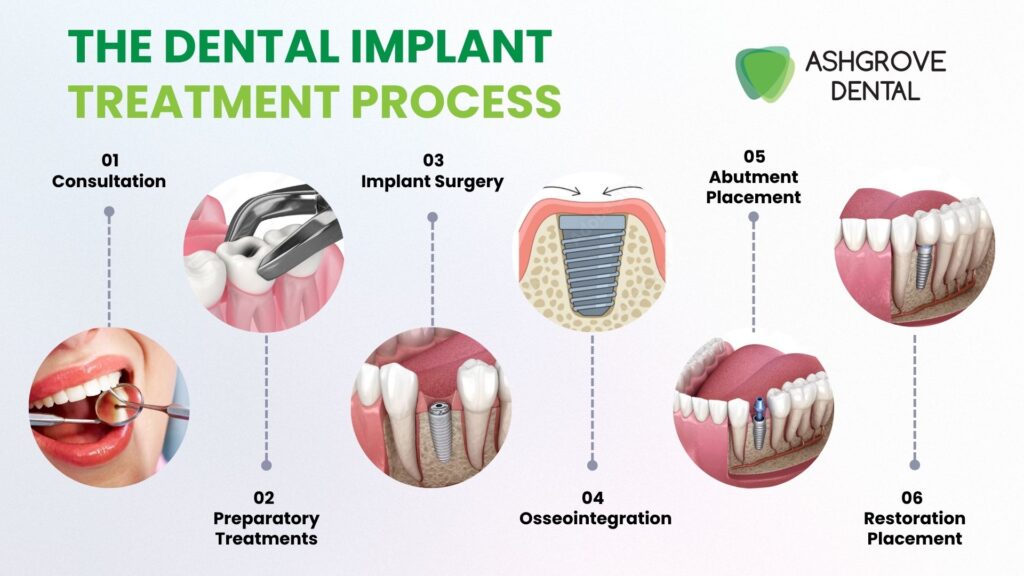
1. Consultation
The first step is a consultation. We will sit down and talk – not just about your missing teeth, but also how it’s affecting you.
We will also examine your mouth and take X-rays and 3D scans. This will allow us to see what’s happening inside your mouth.
Then, if dental implants are right for you, we will develop a personalised treatment plan around your needs, health and goals. You’ll know exactly what you’re signing up for before a single step is taken.
2. Preparatory Treatments (if Needed)
Sometimes, we can’t get started with the implant process right away. For instance, if the bone has lost its volume, we will have to do a bone graft to rebuild it. It’s not a setback. Rather, it’s a step towards creating a solid foundation for your implant(s).
It may feel frustrating – especially when you just want to fill in the gap in your smile and be done with it. But this step will prolong the lifespan of your implants by years.
3. Implant Surgery
Now, this is the part most people worry about.
However, you can rest assured you won’t feel a thing. In most cases, we carry out this part of the procedure under local anaesthesia. You’ll be awake. But you won’t experience the pain.
First, we will expose your jawbone and place the implant post into the bone with utmost precision. Then, we will close the incision, and voila, the foundation is now in place.
4. Osseointegration and Recovery
After implant placement, the implant post undergoes an important process – osseointegration.
This is when your implant fuses with the jawbone, providing a solid and stable foundation for the restoration. It can take about 3 to 6 months for this process, during which we will keep a close eye on things.
We’ll also provide instructions on what you need to do to ensure proper healing. These include eating softer foods, brushing gently and flossing around the area.
5. Abutment Placement
Once healing is complete, it’s time for the most anticipated part of the process. Placing your final restoration.
But before that, we will attach the abutment (a small connecting piece that connects the implant post and dental restoration) in a short procedure of about 1-2 hours.
Then we will give your gums some time to settle around it – usually 2-6 weeks.
6. Restoration Placement
Now comes the moment everything comes together.
Once healing is complete, we will fit your final restoration (a dental crown or bridge). While this is a relatively short appointment (about 30 minutes to an hour), it is done very carefully and precisely to make sure your smile looks right and the new tooth/teeth feel and function right.
So, are dental implants worth the timeline? Yes, absolutely.
Just like good things take time, the dental implant procedure also takes about nine months (give or take). This may sound long, but what you’re getting in return is a lifetime of happy, confident and functional smiles.
At Ashgrove Dental, we plan each and every step carefully to give you a lifetime of comfort, joy and confidence. Want to restore your smile? Call us today!